Proudly serving Phoenix, Scottsdale, Mesa, Chandler, Gilbert, Tempe & surrounding areasCall or Text 24/7: 480-264-9663
Aerial view of a residential neighborhood with saguaros and desert foothills in Phoenix, AZ.

Garage Floor Coatings and Epoxy Systems for Phoenix, AZ Homes

Phoenix Epoxy Co. installs garage floor coatings in Phoenix, including professional two-part epoxy, polyaspartic floors, decorative flake, and metallic epoxy. We also install residential, commercial, and industrial epoxy flooring matched to the slab and traffic load. Concrete polishing, concrete staining, and grind-and-seal work give Valley property owners additional ways to protect and finish concrete.

Phoenix summers can push exposed slabs well past 140 degrees Fahrenheit, while garages also face 115-degree ambient heat, monsoon moisture, and tires that can reach 150 degrees in July. Those conditions can expand and contract bare concrete, drive vapor through the slab, and blister weak coatings. We start with moisture vapor testing and mechanical diamond grinding, then specify UV-stable materials and a coating build suited to the floor.

Our crews carry the licensing required under the Arizona Registrar of Contractors for concrete and coating work. During a free on-site estimate, we evaluate slab condition, moisture, traffic, finish preferences, and the practical differences between epoxy, polyaspartic, polyurea, flake, and metallic systems.

Phoenix Epoxy Co. installs garage floor coatings across Phoenix, Scottsdale, Tempe, Mesa, Chandler, Glendale, and the surrounding Maricopa County metro area.

★ ★ ★ ★ ★4.9/5 Average Rating · 20+ Years of Experience · Thousands of Customers Helped · Licensed & Insured · Residential & Commercial

Garage Floor Coating Options & Benefits

What Is a Garage Floor Coating?

A professional garage floor coating is a bonded system of primer, base coat, optional decorative media, and protective topcoat installed over mechanically profiled concrete. Two-part epoxy chemically bonds to the prepared slab, seals its pores, and creates a monolithic surface that is easier to mop than dusty bare concrete.

Single-component, water-based DIY coatings may be only 2-3 mils thick and can peel within a year or two under Phoenix heat. A professional residential build is commonly 10-20 mils and uses full mechanical preparation rather than acid etching, which produces a stronger mechanical bond.

The right chemistry depends on the floor. Epoxy provides a substantial bonded base, polyaspartic and polyurea offer faster cure and strong UV stability, and flake or metallic treatments add texture or a custom visual finish.

Benefits of Professional Floor Coatings

A properly selected coating changes both how the slab performs and how the garage is used. Material choice, surface profile, film thickness, and topcoat all work together to meet the floor's exposure and traffic.

  • Seals porous concrete against dust and routine drips
  • Resists hot tire pickup with the appropriate system
  • Uses UV-stable topcoats to limit yellowing
  • Makes oil and coolant residue easier to clean
  • Adds texture through flake or aggregate
  • Offers matte, high-gloss, stained, and decorative finishes
  • Supports residential, showroom, commercial, and industrial traffic
  • Provides a cleanable alternative to raw, dusting concrete
Concrete Floor Services

Garage Floor Coating Services

From a two-car garage in Ahwatukee to a showroom off Camelback Road or a warehouse near Sky Harbor, we tailor the floor system to the setting. Each service begins with slab evaluation and preparation before the selected coating or concrete finish is installed.

Standard Garage Floor Epoxy

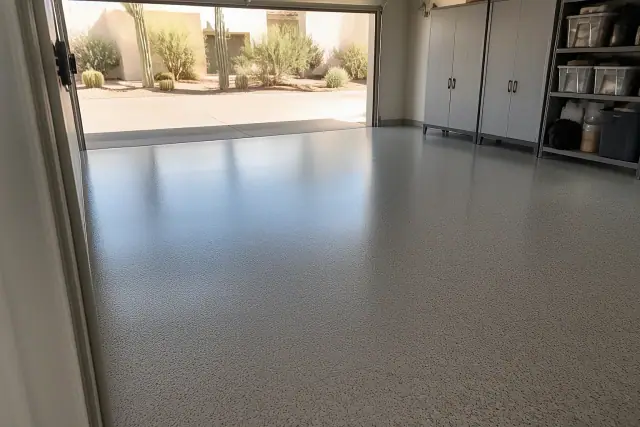
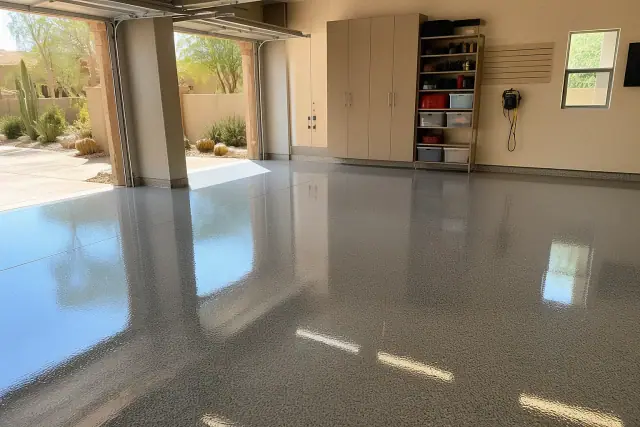
Completed epoxy garage floor with a smooth, glossy finish in a residential home in Phoenix, AZ.

Two-part epoxy forms a durable, bonded surface for garages, laundry rooms, workshops, and converted gym or studio spaces. Primer, base coat, and topcoat are selected around the slab's moisture readings, condition, and intended vehicle or foot traffic.

Request Estimate

Polyaspartic Floor Coatings

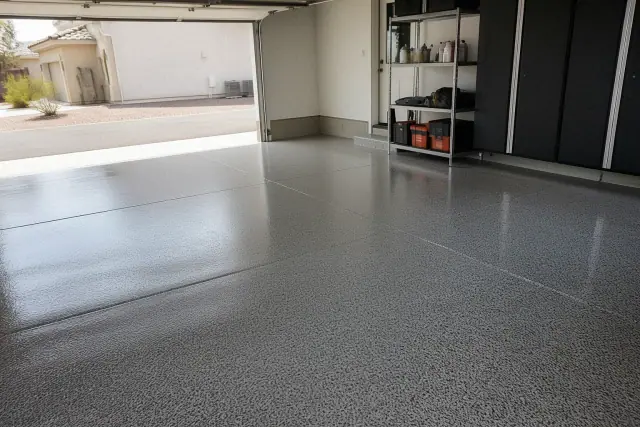
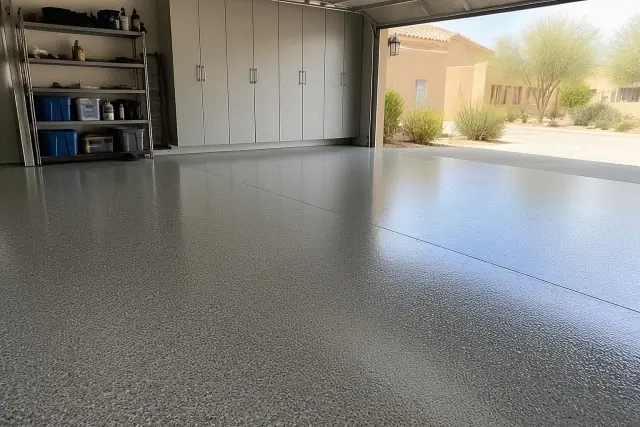
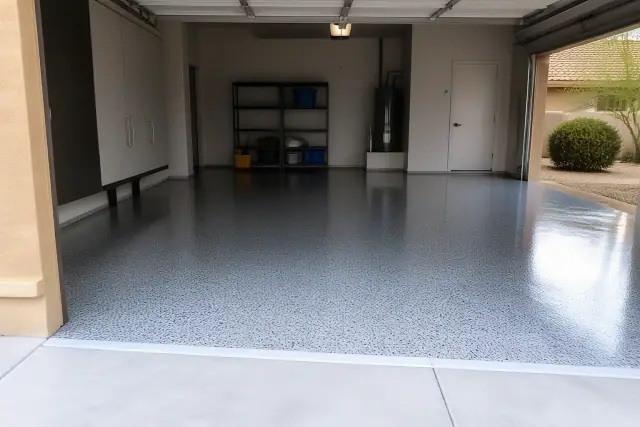
Polyaspartic floor coating with a speckled finish in a residential garage in Phoenix, AZ.

Polyaspartic coatings provide strong UV stability, fast cure, and resistance to hot tire lifting. A polyaspartic topcoat may also be paired with a polyurea base layer for a full system that returns to use faster than traditional epoxy.

Request Estimate

Epoxy Flake Flooring

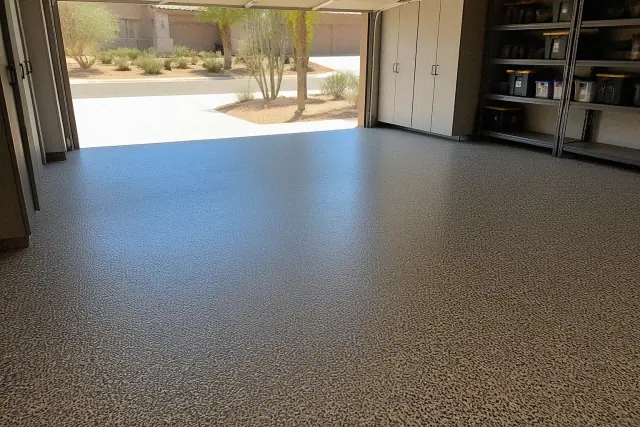
Epoxy flake garage flooring installed in a residential space in Phoenix, AZ.

Colored vinyl chips are broadcast into a wet epoxy base and sealed beneath a clear topcoat. Flake flooring adds texture, offers many blend combinations, and hides tire marks, small debris, and minor slab imperfections better than a solid-color floor.

Request Estimate

Metallic Epoxy Flooring

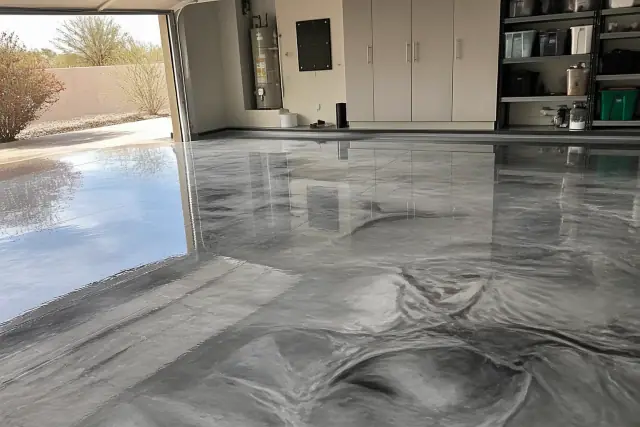
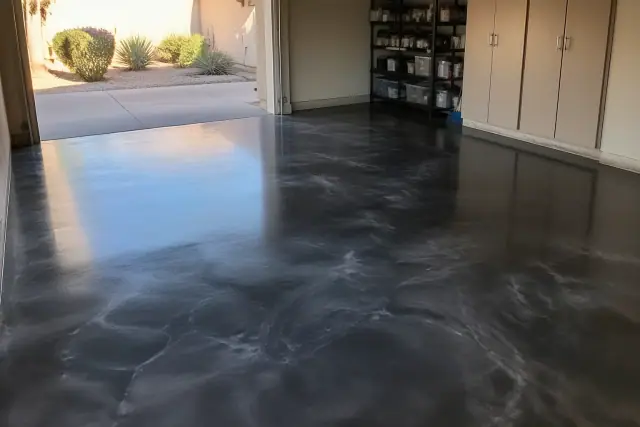
Metallic epoxy flooring with pearlescent swirls in a residential garage in Phoenix, AZ.

Metallic pigments are manipulated in wet clear epoxy with air, squeegees, and brushes to create cells, waves, and three-dimensional depth. No two installations repeat exactly, making the finish suitable for custom garages, showrooms, and statement spaces.

Request Estimate

Commercial and Industrial Epoxy

Completed glossy epoxy garage floor in a residential home with desert landscaping visible outside in Phoenix, AZ.

Commercial systems can incorporate slip-resistant aggregate for retail and restaurant floors exposed to carts and daily foot traffic. Industrial builds for warehouses and manufacturing spaces may reach 20-30 mils with broadcast quartz or aggregate to handle forklifts, hydraulic fluid, battery acid, cleaning solvents, and other demanding loads; a 1,000 square foot standard epoxy shop floor generally falls in the $5,000 to $7,000 range before upgrades.

Request Estimate

Concrete Polishing, Staining, and Grind and Seal

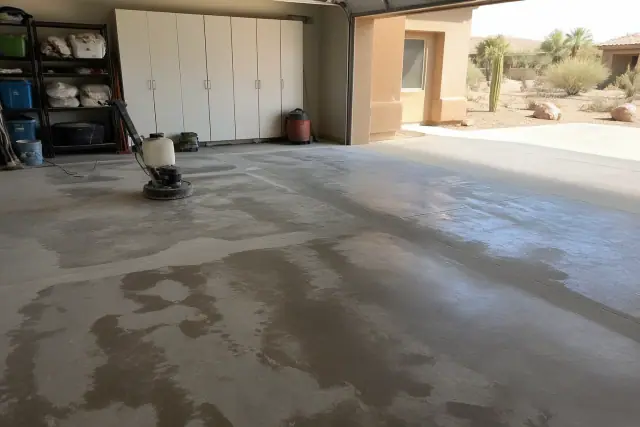
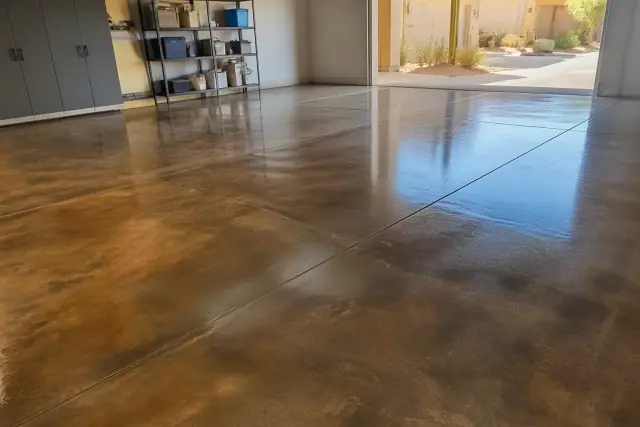
Concrete floor undergoing polishing and staining inside a residential garage in Phoenix, AZ.

Progressively finer diamond tooling can hone or polish concrete without adding a topical coating, while concrete stain adds color to the slab. Grind-and-seal work finishes the prepared surface with a penetrating sealer for a lower-maintenance middle ground between raw concrete and a full coating build.

Request Estimate
Compare Floor Finishes

Types of Garage Floor Coating Options

Coating chemistry, decorative media, finish, thickness, and cure speed all affect performance and budget. These options cover the principal systems and concrete finishes used on Phoenix residential and commercial slabs.

High-gloss two-part epoxy garage floor coating in a residential Phoenix, AZ home.

Standard Two-Part Epoxy

Standard two-part epoxy is a durable residential choice when the slab receives full preparation and a complete primer, base, and topcoat build. Professional installation generally runs $4 to $7 per square foot, depending on slab condition and prep.

  • Commonly built at 10-20 mils for residential traffic
  • Typically lasts 10-20 years with proper installation
  • Resists road salt, oil, and coolant exposure
  • Available in matte or high-gloss finishes
  • Requires a prepared, properly profiled slab
Request Estimate
Finished polyaspartic and polyurea garage floor coating in a Phoenix, AZ residential garage.

Polyaspartic and Polyurea Systems

Polyaspartic uses faster catalyzing chemistry and may be combined with a polyurea base. A standard two-car garage can often be ground, primed, and topcoated in one day, with the coating curing in as little as a few hours.

  • Stronger inherent UV stability than traditional epoxy
  • Reduced risk of yellowing in intense desert sun
  • Light foot traffic may be possible that evening
  • Vehicle use follows after the specified 24-72 hour cure window
  • Resists hot tire lifting in Phoenix garages
Request Estimate
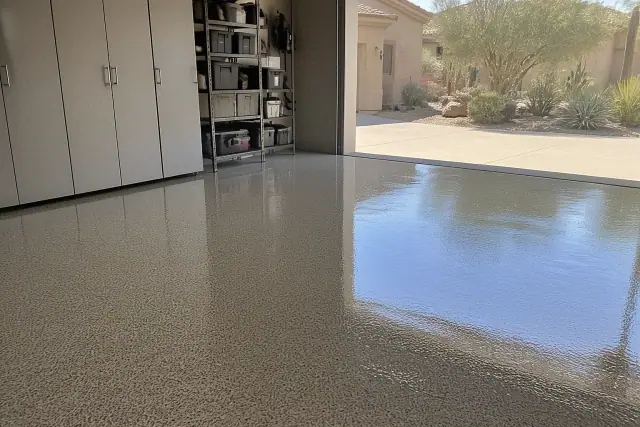
A high-gloss decorative flake garage floor coating in a Phoenix, AZ residence with storage cabinets and desert views.

Decorative Flake Systems

Flake systems are the most requested option for Phoenix garages and generally run $6 to $9 per square foot. The broadcast chips create a textured, forgiving appearance beneath a clear protective topcoat.

  • Typically holds up 10-15 years under normal residential traffic
  • Adds texture and slip resistance
  • Hides tire marks and minor debris
  • Offers dozens of color-blend combinations
  • Works for garages, patios, and pool decks
Request Estimate
Metallic epoxy floor coating with swirling patterns in a residential garage in Phoenix, AZ.

Metallic Epoxy Finishes

Metallic epoxy is the highest-priced residential garage option at roughly $8 to $12 per square foot because its pigment work requires a skilled hand. A 400 square foot garage is generally $3,200 to $4,800.

  • Creates unique cells, waves, and visual depth
  • Can resemble poured stone or lava rock
  • Includes desert copper, slate gray, and deep blue tones
  • Suited to showrooms and custom garage spaces
  • Priced above standard epoxy but below most tile or natural stone
Request Estimate
Polished, stained, and sealed concrete garage floor in Phoenix, AZ, with visible gloss and storage shelving.

Polished, Stained, and Sealed Concrete

Concrete polishing produces a honed or high-gloss sheen by refining the slab itself. Staining or a grind-and-seal approach can add color or stain resistance without the thickness of a full epoxy build.

  • Uses progressively finer diamond tooling
  • Creates a durable, dust-free surface
  • Handles decades of foot and light vehicle traffic
  • Fits showrooms, retail spaces, and residential floors
  • Can reduce reflected heat glare from plain gray concrete
Request Estimate
Finding Your Right Fit

Choosing the Right Floor Coating Approach

A garage used for daily parking has different needs than a custom showroom, restaurant, or forklift aisle. We compare traffic, sunlight, moisture, chemicals, finish preferences, return-to-use needs, and slab repairs before recommending a coating or polished-concrete approach.

Moisture Testing and Slab Diagnostics

Every project starts with a moisture vapor emission test per ASTM F2170 and a visual inspection for cracks, spalling, old coatings, and contamination. Those findings determine whether crack repair, coating removal, or a moisture-mitigating primer is needed.

Mechanical Diamond Grinding

Diamond grinders remove laitance, old paint, and surface contamination while creating the ICRI concrete surface profile specified for the coating. HEPA vacuum shrouds contain the grinding dust, and mechanical profiling provides a stronger bond than acid etching.

Climate- and Traffic-Matched Coating Builds

We specify materials rated for UV exposure and Phoenix thermal swings, then match the system thickness to residential, commercial, or industrial traffic. A wet film gauge checks thickness as the layers are built, and the selected topcoat is chosen to resist amine blush, yellowing, and the floor's expected use.

What Damages Concrete

Garage Floor Problems We Address

Coating failures often begin below the finished surface, where moisture, cracks, contamination, or weak preparation undermine adhesion. Identifying those issues before installation helps us choose the correct repair, primer, profile, and topcoat.

Request a Floor Assessment

Extreme Heat and Thermal Cycling

Repeated heating and cooling expands and contracts exposed concrete. That movement can crack an unsealed slab and stress a thin or poorly bonded coating, especially near open bay doors receiving direct summer sun.

Moisture Vapor Through the Slab

Monsoon downpours can drive moisture upward through a Phoenix slab. If testing shows elevated vapor, installing a standard coating without the appropriate mitigation can lead to blistering or delamination.

Hot Tire Pickup and UV Yellowing

Hot tires can soften or lift budget coatings, while intense sunlight can yellow a topcoat without adequate UV stability. Polyaspartic chemistry and UV-rated finish coats are practical options for floors exposed to Phoenix sun.

Cracks, Spalling, and Old Paint

Slabs poured over expansive desert soils may show settling cracks, while spalling and prior paint create additional weak points. Crack chasing, repair, and extra grinding passes address those conditions before a new floor is built.

Oil, Coolant, and Chemical Stains

Oil and coolant soak into raw concrete, while industrial floors may also encounter hydraulic fluid, battery acid, and cleaning solvents. Degreasing and contamination removal are essential before applying a chemical-resistant system.

Dusting, Slippery, Hard-to-Clean Concrete

Bare concrete releases dust and absorbs spills, while a smooth solid-color coating may not provide enough texture for every use. A sealed surface is easier to mop, and flake, quartz, or aggregate can be incorporated when added slip resistance is appropriate.

How It Works

Our Garage Floor Coating Process

A durable floor depends on the work completed before the decorative finish appears. Our process moves from testing and repairs through controlled surface preparation, application, cure, and aftercare.

01.

On-Site Evaluation and Moisture Test

We inspect how the space is used, discuss finish and return-to-use priorities, and test slab moisture. The on-site estimate is based on those findings rather than square footage alone.

02.

Crack and Coating-Failure Assessment

We identify cracks, spalling, old paint, laitance, and contaminated areas. Any needed crack chasing, repairs, or prior-coating removal is included in the preparation plan.

03.

Diamond Grinding and Dust Control

Diamond grinders mechanically open and profile the concrete to the required ICRI standard. HEPA-connected shrouds capture dust while the equipment removes weak surface material, paint, and residue.

04.

Cleaning, Degreasing, and Priming

The profiled slab is vacuumed and degreased so contamination does not interfere with adhesion. Where vapor readings warrant it, we apply a moisture-mitigating primer before the base coat.

05.

Base, Decorative Layer, and Topcoat

We install the specified base coat, broadcast flake or manipulate metallic pigment when selected, and finish with a clear topcoat. A wet film gauge is used during application to control coating thickness rather than relying on appearance alone.

06.

Cure Window and Aftercare

Depending on the product and conditions, standard epoxy may need 24-72 hours before foot traffic and 5-7 days-up to a week-before full vehicle weight. Faster polyaspartic or polyurea systems may allow light traffic the same day and vehicles within 24-72 hours; for every system, avoid harsh chemical spills during the first 30 days of full chemical cure.

Plan Your Floor

Schedule a Garage Floor
Coating
Estimate

Get an on-site evaluation of your slab, moisture conditions, repair needs, coating options, finish, and expected traffic. Phoenix Epoxy Co. will use those details to prepare an honest estimate for the system that fits the space.

Garage Floor Help

Garage Floor Coating FAQs

Compare garage floor coating costs, cure times, preparation methods, maintenance, and finish options before planning your Phoenix project. Final recommendations depend on moisture readings, slab condition, traffic, and the appearance you want.

Call Our Team

Standard two-part epoxy generally runs $4 to $7 per square foot installed, decorative flake runs $6 to $9, and metallic epoxy runs $8 to $12. Final pricing depends on moisture readings, cracks, prior-coating removal, grinding, system thickness, and the selected finish, so Phoenix Epoxy Co. provides an on-site estimate rather than pricing from square footage alone.

A 20x20 garage is 400 square feet. A standard epoxy system is typically $2,000 to $2,800, decorative flake is $2,400 to $3,600, and metallic epoxy is $3,200 to $4,800; cracks, old coatings, or high moisture readings can add to the final cost.

A two-car garage closer to 500 square feet costs proportionally more than the 400 square foot example. A 1,000 square foot shop floor generally runs $5,000 to $7,000 for standard epoxy before decorative, industrial, repair, or preparation upgrades.

Traditional epoxy may require 24-72 hours before foot traffic and 5-7 days, or up to a week, before full vehicle weight. Polyaspartic and polyurea systems can allow light traffic the same day and vehicles within 24-72 hours, but the exact product and conditions control the return-to-use schedule.

Polyaspartic offers faster cure, stronger inherent UV stability, and less risk of yellowing in intense sun. Two-part epoxy provides a substantial bonded base, so the best choice may be epoxy, polyaspartic, or a polyurea-base hybrid based on sunlight, traffic, moisture, and return-to-use priorities.

A properly prepared professional epoxy floor can last 10-20 years. A flake system with a polyaspartic or urethane topcoat commonly holds up 10-15 years under normal residential traffic, with slab condition, preparation, use, and maintenance influencing service life.

Mechanical diamond grinding removes laitance, old paint, and contamination while producing the ICRI surface profile specified for the coating. Acid etching does not create the same strong mechanical bond, so Phoenix Epoxy Co. uses grinders with HEPA vacuum shrouds for preparation and dust control.

Moisture vapor moving through a slab can blister or delaminate a coating. Testing per ASTM F2170 helps determine whether the slab needs a moisture-mitigating primer before the coating build begins.

Vinyl flakes add texture and help conceal tire marks, small debris, and minor slab imperfections better than a solid color. The chips are broadcast into the wet base coat and locked beneath a clear polyaspartic or urethane topcoat.

Metallic pigments suspended in clear epoxy are moved while wet with air, squeegees, and brushes. The technique pushes pigment into cells and waves, creating a custom stone- or lava-like finish that does not repeat exactly from floor to floor.

Dust mop weekly and damp mop monthly with a neutral cleaner. Avoid acid-based cleaners that can dull the topcoat, and keep harsh chemical spills off a new coating during its first 30 days of chemical cure.

Yes, when the system is designed for the traffic and exposure. Commercial floors can use slip-resistant aggregate for carts and daily foot traffic, while industrial systems may use a 20-30 mil build with quartz or aggregate for forklifts, hydraulic fluid, battery acid, and cleaning solvents.

Phoenix Epoxy Co. installs garage floor coatings throughout Phoenix, Scottsdale, Tempe, Mesa, Chandler, Glendale, and the surrounding Maricopa County metro area. The company also handles commercial and industrial floors along the I-17 and I-10 corridors.