Proudly serving Phoenix, Scottsdale, Mesa, Chandler, Gilbert, Tempe & surrounding areasCall or Text 24/7: 480-264-9663
Aerial view of a residential neighborhood with saguaros and desert foothills in Phoenix, AZ.

Industrial Epoxy Flooring Installation for Manufacturing Facilities in Phoenix, AZ

Phoenix Epoxy Co. installs industrial epoxy flooring for manufacturing plants, warehouses, cold storage facilities, aerospace suppliers, auto service bays, and distribution centers in Phoenix, Arizona. We also install polyaspartic floor coatings, epoxy flake floors, metallic epoxy finishes, concrete polishing, concrete staining, and grind-and-seal flooring. Each system is selected for the slab, traffic, chemical exposure, and operating schedule. The result is a floor specification built around the facility rather than a generic coating.

Phoenix summer heat can push concrete slab surface temperatures past 140 degrees Fahrenheit. Caliche-heavy desert soil across much of the Salt River Valley can also contribute to moisture vapor transmission problems that standard sealers are not designed to manage. Forklift traffic, chemical spills, and thermal cycling add more stress inside working facilities along the I-10 and I-17 corridors. Careful testing, mechanical preparation, and a purpose-built resin system help prevent premature wear and coating failure.

Every industrial project begins with moisture vapor testing and a concrete assessment consistent with International Concrete Repair Institute surface-preparation guidelines. Our crews hold the appropriate Arizona Registrar of Contractors licensing for the flatwork and coatings we install and follow Maricopa County Air Quality Department VOC requirements on each job.

Phoenix Epoxy Co. installs industrial epoxy flooring throughout Phoenix and the surrounding metro, including Scottsdale, Glendale, Chandler, Tempe, Mesa, and the greater Salt River Valley.

★ ★ ★ ★ ★4.9/5 Average Rating · 20+ Years of Experience · Thousands of Customers Helped · Licensed & Insured · Residential & Commercial

Industrial Epoxy Flooring Options & Benefits

What Is Industrial Epoxy Flooring?

Industrial epoxy flooring is a multi-layer resin system bonded directly to the concrete substrate. A typical specification combines primer, a high-build body coat, and a protective topcoat to create a monolithic wear surface.

In manufacturing and distribution spaces, the coating helps spread point loads while resisting dusting, spalling, and pitting from repeated forklift and pallet jack traffic. Keeping concrete dust out of HVAC filters and product lines can also simplify ongoing facility maintenance.

The seamless surface removes the grout lines and joints where moisture, debris, and bacteria collect in tile or brick floors. That continuity makes routine cleaning and sanitation documentation more manageable in food-processing and pharmaceutical environments.

Benefits of Industrial Epoxy Flooring

A correctly specified industrial floor can protect the slab while making a demanding facility easier to operate. The final resin, texture, and topcoat are selected around the building's actual exposure profile.

  • Resists oils, solvents, battery acid, and daily cleaning chemicals
  • Handles repeated forklift and pallet jack abrasion
  • Reduces concrete dusting around equipment and product lines
  • Creates a seamless surface without debris-catching grout lines
  • Supports anti-slip textures for working areas
  • Simplifies cleaning in sanitation-sensitive facilities
  • Allows flake, metallic, and custom decorative finishes
  • Can be phased around active operations and planned shutdowns
Industrial Flooring Services

Industrial Epoxy Flooring Services

Phoenix facilities range from single-bay maintenance shops to multi-acre warehouse floors, so the right coating is never automatic. We scope the slab condition, traffic, chemicals, thermal load, appearance goals, and reopening schedule before recommending a system.

Industrial-Strength Epoxy Floors

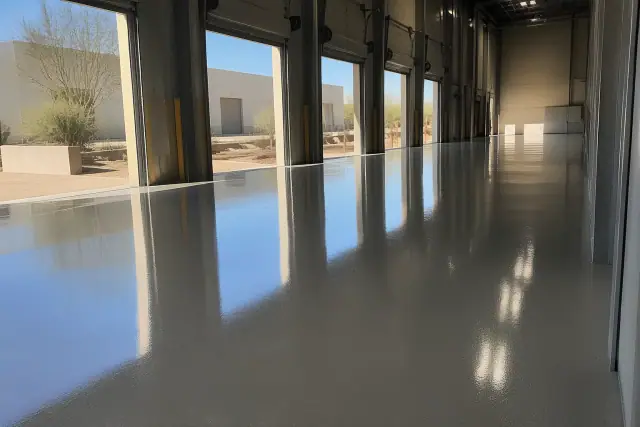
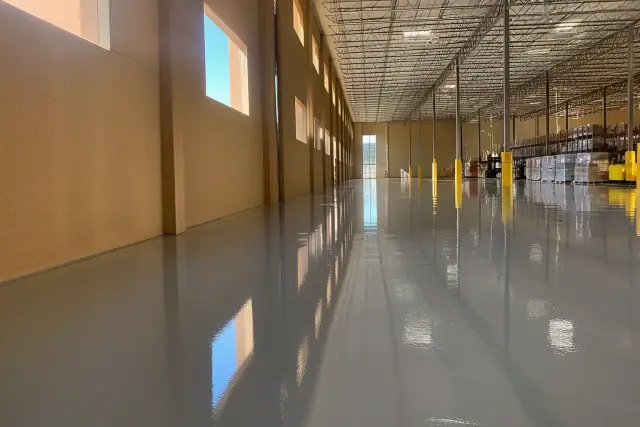
Glossy industrial epoxy flooring inside a warehouse with desert views through open bay doors in Phoenix, AZ.

High-build epoxy resin flooring is designed for plants, warehouses, cold storage, and service bays exposed to heavy traffic and chemicals. The build thickness and topcoat are matched to point loads, abrasion, cleaning products, and thermal conditions.

Request Estimate

Polyaspartic Floor Coatings

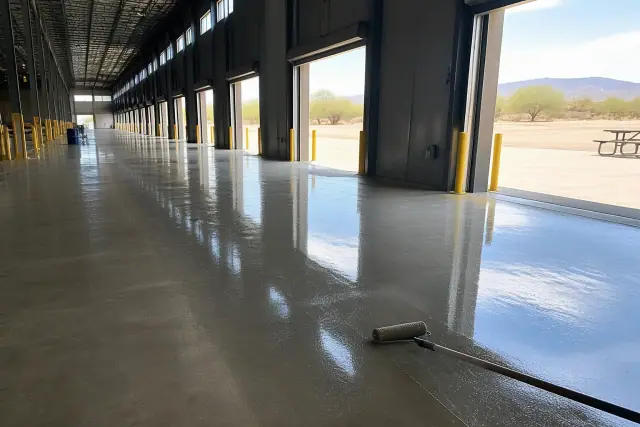
Wet polyaspartic floor coating being applied to a warehouse floor in Phoenix, AZ.

Polyaspartic coatings cure faster than standard epoxy and resist UV yellowing, making them practical for facilities with tight shutdown windows or sun-exposed transitions. They may be used as a complete coating or as a topcoat over an epoxy body layer.

Request Estimate

Epoxy Flake Flooring

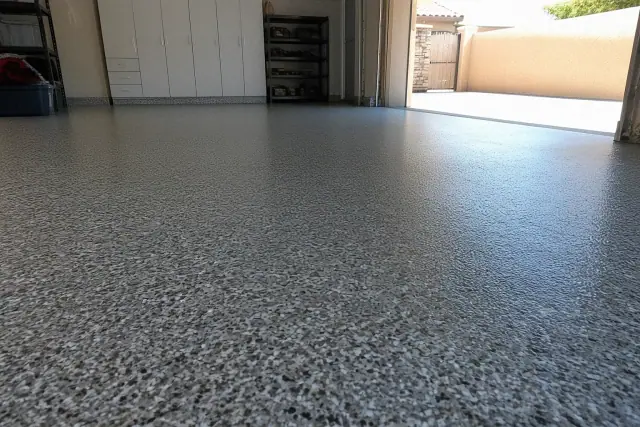
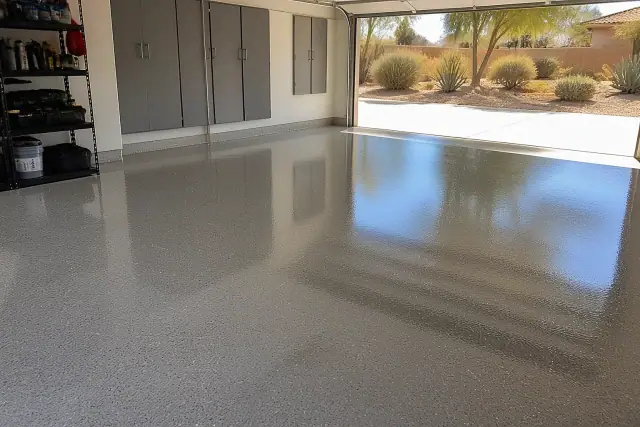
Epoxy flake flooring inside a residential garage in Phoenix, AZ, showing texture and color variation in natural light.

Epoxy flake flooring broadcasts colored vinyl chips into the base coat before a clear protective topcoat is applied. The flakes add texture for improved slip resistance, help mask minor surface variation, and provide a durable visual finish.

Request Estimate

Metallic Epoxy Flooring

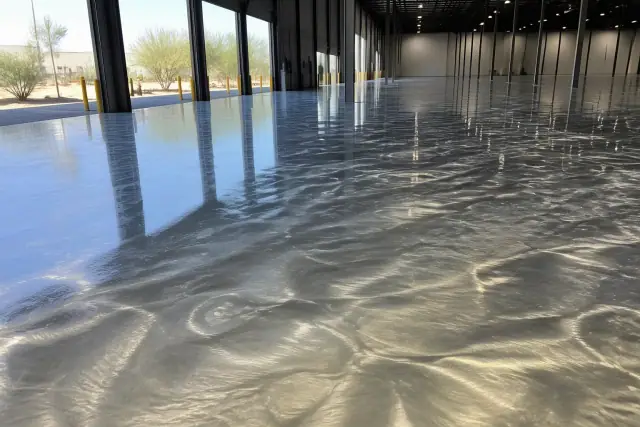
Metallic epoxy flooring with a pearlescent finish in a Phoenix, AZ warehouse under natural sunlight.

Metallic epoxy suspends mineral pigments in clear resin and is manipulated during application to produce a three-dimensional, marbled appearance. It is especially useful in industrial lobbies, showrooms, and break areas where visual impact matters alongside durability.

Request Estimate

Concrete Polishing and Staining

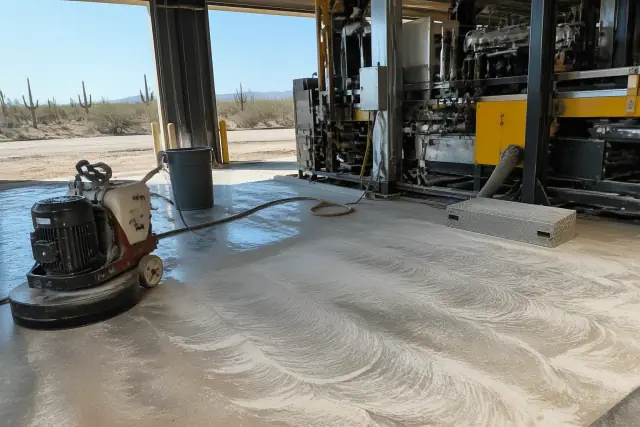
Industrial concrete floor with polishing equipment and machinery inside a warehouse in Phoenix, AZ.

Polished or stained concrete offers an attractive, low-maintenance finish for retail areas and showrooms with lighter exposure. Because these finishes do not add meaningful chemical or impact resistance, they are not the right substitute for epoxy in demanding production or warehouse zones.

Request Estimate

Grind-and-Seal Flooring

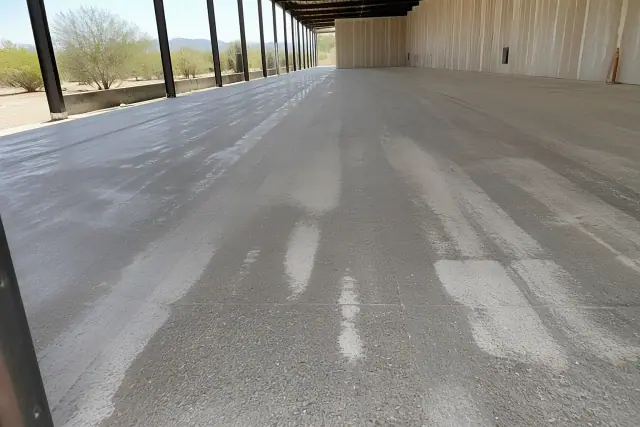
Concrete floor in a Phoenix, AZ warehouse showing grinding dust and aggregate during surface preparation.

Grind-and-seal flooring exposes and cleans the concrete before applying a penetrating sealer. It is a lower-cost fit for light-use commercial areas, but the sealer wears under rolling loads and does not provide the abrasion resistance required in busy distribution centers.

Request Estimate
System Selection

Industrial Floor Coating Options

Chemical resistance, abrasion, UV exposure, shutdown time, and visual goals all change the right floor specification. These options cover heavy production areas, fast-return spaces, decorative zones, and lighter-duty commercial floors without treating them as interchangeable.

High-gloss industrial epoxy flooring in a Phoenix, AZ warehouse with sunlight filtering through clerestory windows.

100% Solids Industrial Epoxy

A 100% solids, two-component epoxy system creates a dense body coat with high compressive strength and strong chemical resistance. It is suited to heavy-duty areas where film build and substrate bond take priority over rapid reopening.

  • Dense resin body coat for demanding traffic
  • Strong resistance to oils, solvents, and battery acid
  • High compressive strength for point loads
  • Primer, body coat, and protective topcoat configuration
  • Built for manufacturing and warehouse conditions
Request Estimate
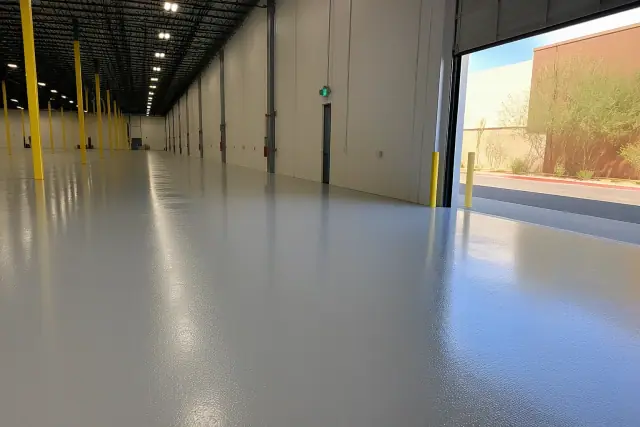
Completed high-build epoxy flooring in a logistics warehouse in Phoenix, AZ, seen through an open bay door.

High-Build Epoxy Systems

High-build epoxy adds substantial film thickness for floors exposed to rolling traffic, impact, and aggressive cleaning. Slab damage, failed coatings, oil saturation, and cracks must be addressed during preparation so the added build bonds to sound concrete.

  • Added film build for rolling and point loads
  • Abrasion resistance for repeated material handling
  • Compatible with specified broadcast or trowel applications
  • Topcoat selected for the facility's exposure
  • Preparation plan tailored to existing slab damage
Request Estimate
Glossy polyaspartic floor coating with decorative flakes inside a residential garage in Phoenix, AZ.

Polyaspartic Floor Coatings

Polyaspartic floor coatings cure in hours rather than days and resist UV yellowing better than standard epoxy. They are often the practical choice when a facility cannot accommodate a 72-hour shutdown, even though epoxy has the edge in raw chemical resistance.

  • Faster cure for tight shutdown windows
  • Better resistance to UV yellowing
  • Useful as a rapid-return complete system
  • Available as a topcoat over an epoxy body layer
  • Suited to sun-exposed facility transitions
Request Estimate
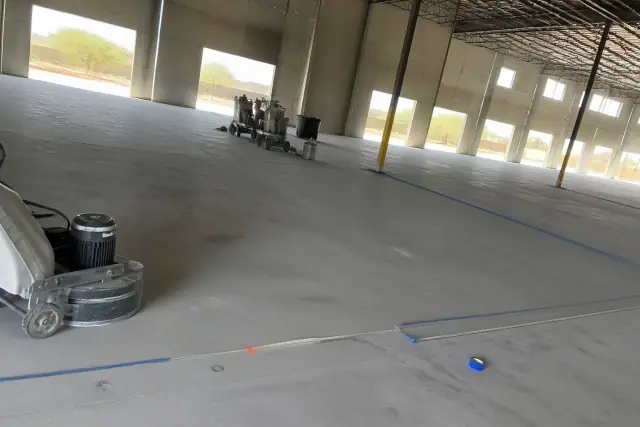
Raw concrete floor with industrial grinders in a warehouse awaiting epoxy coating in Phoenix, AZ.

Metallic Epoxy Finishes

Metallic epoxy combines a clear resin base with manipulated mineral pigments for a marbled, dimensional finish. It brings a polished presentation to lobbies, corporate showrooms, and break areas adjacent to industrial operations.

  • Mineral pigments suspended in clear epoxy resin
  • Three-dimensional marbled visual effects
  • Custom floor designs for presentation areas
  • Protective topcoat over the decorative layer
  • A fit for lobbies, showrooms, and break areas
Request Estimate
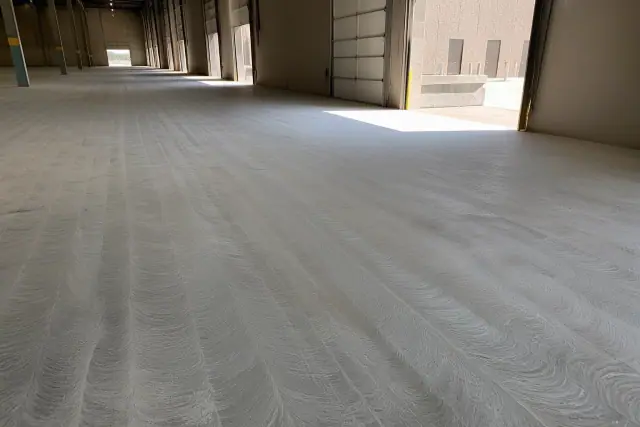
Mid-process grind-and-seal concrete floor with scratch patterns in a Phoenix, AZ warehouse.

Grind-and-Seal Flooring

Grind-and-seal flooring typically costs $2 to $5 per square foot and works for lighter-use commercial spaces. Its penetrating sealer wears thin under rolling loads, making it the wrong fit for a distribution floor running pallet jacks eight hours a day.

  • Lower upfront cost for light-use spaces
  • Exposes and seals the prepared concrete surface
  • Appropriate for selected retail or showroom areas
  • Limited abrasion protection under rolling traffic
  • Not a substitute for heavy-duty industrial epoxy
Request Estimate
Finding Your Right Fit

Choosing the Right Industrial Flooring Approach

The correct floor begins with the slab and operating environment, not a preset coating package. We evaluate moisture, prior failures, traffic, chemicals, sanitation needs, thermal load, appearance, and the production calendar before defining the preparation and resin system.

Moisture and Slab Assessment

Testing comes before coating because unresolved vapor movement, laitance, cracks, and old failures can undermine an otherwise strong resin system. Phoenix slabs over caliche-heavy subgrade deserve direct measurement rather than assumptions.

Facility-Specific Floor Specification

A pharmaceutical packaging floor and a tire distribution warehouse do not need the same coating. We size primer, body coat, texture, and topcoat around each facility's traffic, chemicals, thermal exposure, sanitation needs, and appearance goals.

Phased Installation Scheduling

Industrial flooring work can be planned around active operations, off-hour shifts, and phased shutdowns. We coordinate the coating choice and cure window with the production calendar so reopening is deliberate rather than improvised.

What Sets Us Apart

Why Choose Phoenix Epoxy Co. for Industrial Epoxy Flooring?

Our team brings decades of combined field experience to industrial resin flooring across the Valley. We hold the appropriate Arizona Registrar of Contractors licensing for the flatwork and coatings we install, follow Maricopa County Air Quality Department VOC requirements, and inspect the site before quoting the work.

Request Site Assessment

Concrete Dusting and Spalling

Bare concrete can dust, pit, and spall under repeated material-handling traffic. The loose dust reaches HVAC filters and production areas, while the damaged surface becomes harder to clean and less suitable for a bonded coating.

Moisture Vapor Transmission

Vapor moving through a slab can break the bond between concrete and coating. Because caliche-heavy desert subgrade can produce unexpected transmission rates, a moisture vapor emission test is essential before the system is specified.

Chemical Etching and Stains

Hydraulic fluid, oils, solvents, battery acid, degreasers, and acidic cleaners can etch or stain unprotected concrete. A resin system must be selected for the facility's actual chemical exposure rather than a general-purpose coating label.

Forklift and Pallet Jack Wear

Forklift tires, pallet jack wheels, turning loads, and dropped materials create concentrated wear. Retail-grade films and penetrating sealers lack the body and abrasion resistance needed for sustained industrial traffic.

Thermal Cycling and Heat

Phoenix heat and temperature changes place recurring stress on concrete and its coating bond. Cold storage, sun-exposed transitions, and hot service areas each need a system evaluated for their specific thermal load.

Early Coating Delamination

Coatings often lift early when installers skip vapor testing, leave laitance, or apply resin over oil contamination and failed material. Mechanical preparation and a clean, open concrete profile are fundamental to adhesion.

How It Works

Our Industrial Epoxy Flooring Process

Each project follows a disciplined sequence from facility review through reopening. The scope accounts for slab condition, surface profile, containment, resin application, cure requirements, and the operating schedule.

01.

Site Walk and Needs Assessment

We walk the facility to document traffic patterns, point loads, chemical exposure, thermal conditions, sanitation needs, existing failures, and shutdown constraints. Those findings guide the preliminary system and phasing plan.

02.

Moisture Testing and Slab Inspection

A moisture vapor emission test is paired with a visual review of cracks, control joints, oil saturation, previous coatings, and damaged concrete. The assessment determines what must be removed or repaired before coating.

03.

Diamond Grinding and Dust Control

We mechanically diamond-grind the slab to an ICRI CSP 3 profile or better, removing laitance and opening the concrete for a mechanical bond. HEPA-filtered vacuum systems contain dust during preparation in support of Maricopa County Air Quality Department particulate requirements.

04.

Repairs and Primer Application

Specified cracks and damaged areas are repaired after failed material and contamination are addressed. Primer is then applied to the prepared slab as the first bonded layer of the flooring system.

05.

Body Coat and Topcoat Application

The body coat is broadcast or troweled at the specified thickness, followed by a rolled or squeegeed topcoat. Industrial epoxy coating thickness typically runs 20 to 40 mils, well beyond the film build of a retail-grade DIY kit.

06.

Cure and Facility Reopening

Standard epoxy systems need roughly 24 hours before foot traffic and 3 to 7 days for full cure and heavy loads. Polyaspartic systems can permit reopening in as little as 24 to 48 hours, so the planned operating schedule helps determine the final coating choice.

Plan Your Facility Floor

Schedule an Industrial Epoxy Flooring Consultation

Tell us how the facility operates, what the slab is doing now, and when the space can be taken out of service. Phoenix Epoxy Co. will walk the site, review the conditions, and define a coating scope before quoting the project.

Industrial Flooring Help

Industrial Epoxy Flooring FAQs

These answers cover system selection, preparation, pricing, cure windows, maintenance expectations, and Phoenix slab conditions. A site assessment is still necessary to match the coating to the concrete and operating environment.

Call Our Experts

Industrial epoxy flooring is a multi-layer resin system bonded directly to prepared concrete. It typically combines primer, a high-build epoxy body coat, and a protective topcoat to create a seamless, chemical-resistant wear surface.

100% solids epoxy for industrial applications typically runs $4 to $7 per square foot, while high-build epoxy systems are closer to $3 to $6 per square foot. Metallic epoxy used in showrooms or lobbies typically runs $7 to $9 per square foot because of the added pigment work and labor.

Slab condition is often the largest variable because failed coatings, oil saturation, and extensive cracking add grinding and repair work. For a smaller-project benchmark, a 20x20 garage floor is roughly 400 square feet and typically lands between $1,600 and $3,200 depending on the coating system and required preparation; industrial facilities are scoped around their own size, loads, exposure, and shutdown plan.

Standard epoxy systems need roughly 24 hours before foot traffic and 3 to 7 days for full cure and heavy loads. Polyaspartic systems can allow reopening in as little as 24 to 48 hours, which can make them a better fit for a tight production window.

Industrial epoxy floors can last 10 to 20 years in lighter-duty commercial settings and 5 to 10 years in heavy industrial environments before recoating is needed. By comparison, unprotected concrete may begin dusting and pitting within 2 to 3 years under demanding use.

Moisture vapor moving through a slab can break the coating bond and cause early delamination. Caliche-heavy subgrade across much of the Salt River Valley can produce unexpected vapor transmission, so we test the slab instead of guessing.

The slab is inspected for cracks, control joints, contamination, and previous coating failures before being mechanically diamond-ground. We prepare to an ICRI CSP 3 profile or better and use HEPA-filtered vacuum equipment to contain dust and expose sound concrete for the bond.

Industrial-strength epoxy can resist oils, solvents, battery acid, degreasers, and cleaning chemicals that would stain or etch bare concrete. The exact resin and topcoat still need to be matched to the chemicals and cleaning practices used in the facility.

Epoxy provides stronger chemical resistance and greater build thickness for heavy industrial loads. Polyaspartic cures faster and resists UV yellowing better, so it may be more practical when the facility cannot accommodate a 72-hour shutdown.

Yes. Broadcast texture or an epoxy flake system can add grip while the final topcoat seals the surface. The texture should be selected around traffic, cleaning methods, and the conditions in each work area.

A seamless epoxy surface eliminates the grout lines where bacteria, moisture, and debris can collect in tile or brick flooring. That makes sanitation and related documentation more manageable for food-processing and pharmaceutical spaces, while the exact system is still matched to the facility's exposures.

Yes. Metallic epoxy can create marbled effects for lobbies and showrooms, while vinyl flake systems add texture and visual variation in work or support areas. Production zones should still prioritize traffic, chemical, and thermal requirements over appearance alone.

We install industrial epoxy flooring throughout Phoenix and the surrounding metro. Supported service areas named for this work include Scottsdale, Glendale, Chandler, Tempe, Mesa, and the greater Salt River Valley.