Plan on 4-6 Hours
Most Phoenix floors are ready for careful foot traffic in 4-6 hours. On a typical summer day, ambient heat can shorten that window to as little as 3-4 hours, while cooler conditions may call for the full 6 hours.
For a freshly coated Phoenix garage or shop, Phoenix Epoxy Co. recommends planning on 4-6 hours before light foot traffic in socks or soft-soled shoes. The floor may feel dry sooner, but full hardness and chemical resistance develop over the following days.
Most Phoenix floors are ready for careful foot traffic in 4-6 hours. On a typical summer day, ambient heat can shorten that window to as little as 3-4 hours, while cooler conditions may call for the full 6 hours.
Warm slabs and Phoenix's low humidity speed the reaction, but heat above 110°F shortens application working time. Cure slows below 55°F, so slab temperature matters more than the clock alone.
Use only socks or soft-soled shoes at first, wait 24 hours for vehicles, and avoid dragging metal furniture or tool chests for 72 hours. Wipe up spills promptly until full chemical resistance develops.
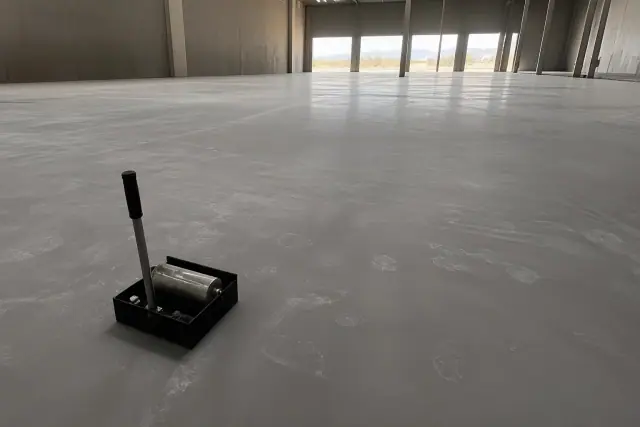
Socks or soft-soled shoes stepping onto a finished garage floor without tools or heavy objects. This is the safe first-use window under normal Phoenix conditions.
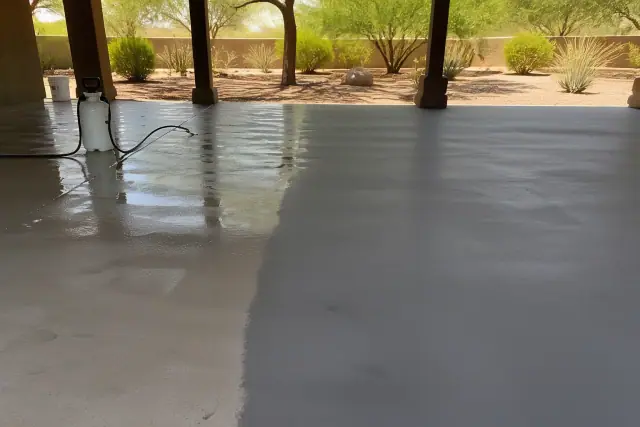
Compare a warm Phoenix slab with a cooler slab to make temperature's effect visible. Warmer surfaces accelerate cure, while temperatures below 55°F slow it.
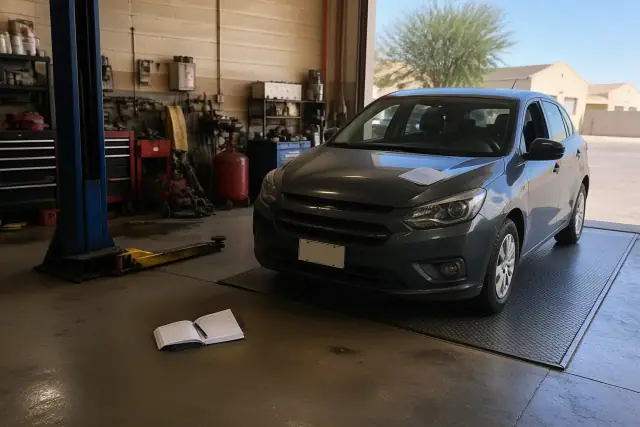
A vehicle entering only after the full 24-hour wait. Foot traffic readiness does not mean the coating is ready for tire load and vehicle weight.
The surface is usually dry to the touch, but it is not yet load-bearing. Keep people, pets, and equipment off it.
Careful foot traffic in socks or soft shoes is normally fine. Do not drag anything abrasive across the coating.
Cars, trucks, furniture, and normal foot traffic can typically return. Treat the first 24 hours as a no-vehicle period in every season.
Full chemical resistance generally develops from 72 hours to 5 days. Complete cure and hardness for heavy equipment may take 5-7 days.
| Cure milestone | Typical timing | How to use the floor |
|---|---|---|
| Surface set | 2-4 hours | Dry to the touch, but not yet load-bearing. |
| Light foot traffic | 4-6 hours | Use socks or soft-soled shoes; do not drag tools or furniture. |
| Vehicle return | 24 hours | Cars, furniture, and normal foot traffic can usually return. |
| Chemical resistance | 72 hours to 5 days | Keep gas, oil, brake fluid, and harsh cleaners from sitting on the coating before this window. |
| Complete cure | Day 5-7 | Full hardness for heavy equipment or industrial use. |
Polyaspartic is a polyurea-based topcoat that starts cross-linking as soon as the final coat is applied. Dry means the surface is no longer wet; cured means the polymer has reached full hardness and chemical resistance. The coating is scratch-resistant rather than scratch-proof, so dragging a steel toolbox or dropping a heavy wrench can still leave a mark. Its UV stability also helps flake and metallic finishes resist the ambering that standard epoxy can show within a year or two under direct Phoenix sun.
Salt River Valley conditions can range from winter mornings in the 50s to summer afternoons over 110°F, so slab and air temperatures change both working time and cure speed. Phoenix relative humidity is often under 30% in summer, which generally helps the coating cure faster than it would in humid conditions. Thicker flake or metallic systems take longer than a single thin topcoat, and a high-build epoxy basecoat under a polyaspartic finish adds another system layer to account for. Open-garage airflow speeds off-gassing and surface hardening, while fast-set versus slow-set formulations can shift full cure time by a day or more.
Most polyaspartic odor clears within 4-6 hours when the garage door is open and a fan is moving air. Once concrete grinding, crack repair, and the basecoat are complete, applying the topcoat across a standard two-car garage typically takes 2-4 hours, so a two-hour estimate describes the coating step rather than the full project; a straightforward, properly prepared garage can still be a same-day installation. Polyaspartic cures roughly 5-10x faster than standard epoxy, which often needs 5-7 days before regular vehicle traffic. After cure, normal foot traffic, rolling tires, and pet nails should not damage the surface, but dragging jack stands or steel toolboxes can mark it.
Share when the final coat was applied, the current slab and air conditions, the coating system, and what you need to move back into the space. The installation team can confirm a practical foot-traffic, vehicle, and heavy-load timetable for your Phoenix garage or shop.